NAGOYA PROTOCOL (5:04 PM):
- It aims to ensure that the benefits arising from the exploitation of genetic resources are shared fairly and equitably.
- It brings the Access and Benefit Sharing( ABS) mechanism.
- This protocol was signed in 2010 under the Convention on Biodiversity as a supplementary agreement.
- It covers the resources protected under CBD, including the traditional knowledge of indigenous communities.
- This lays three types of obligations over the signatory parties:
Access Obligation:
- The protocol obligates the parties to pass laws to provide fair and transparent rules.
- The rules should provide access to their genetic resources based on Prior Informed Consent (PIC).
- These rules should also encourage research that contributes to biodiversity conservation.
Benefit Sharing Obligation:
- Developed countries must share the benefits arising out of the usage of biological resources with developing countries.
- All parties to CBD have to provide for benefit sharing under their national laws.
- The benefits according to the Nagoya protocol include monetary and non-monetary benefits.
- The research outcomes and the methods of research are some of the non-monetary benefits.
Compliance Obligations:
- All institutions will have to follow the domestic rules and laws when they access genetic resources and traditional knowledge.
- This also includes complying with the rules & procedures of regulatory institutions dealing with biological resources and traditional knowledge.
- Compliance also includes the right of the country of origin of the biological resource to know how genetic resources are being researched and how the products derived from them are being commercialized.
AICHI BIODIVERSITY TARGETS (5:35 PM):
- These were framed in 2010 in Aichi, Japan.
- The targets are under different strategic goals in different areas of biodiversity use and conservation.
- The targets deal with biodiversity targets for the period 2011-2020.
- The time frame has been extended by 5 more years.
The five strategic goals are:
- I. Goal A:
- All countries must identify and deal with the underlying causes responsible for the loss of biodiversity by 2020.
- This includes practices like bottom trawling, etc.
-
Bottom Trawling:
- This is a fishing practice that includes towing a large net along the ocean floor.
-
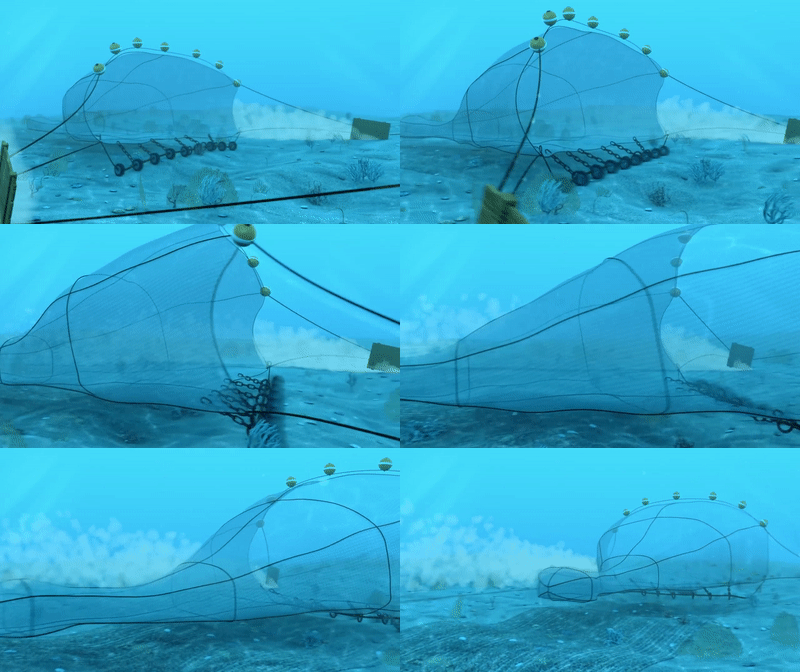
- The practice is hazardous for the marine ecosystem because the sea floor gets damaged.
- This process is non-discriminatory and catches a large number of non-target species and objects along with the target fish.
- The rest products are discarded.
- II. Goal B:
- Reduce direct pressure on biodiversity and promote its sustainable use.
- Some actionable principles under this goal are:
- (a) reduced deforestation rate by half by 2020.
- (b) Reduce habitat loss rate by half by 2020.
- III. Goal C:
- Improve the status of biodiversity by safeguarding ecosystems, species diversity, and genetic diversity.
- Actionable principles for its goal are:
- (a) Bring at least 17 % of terrestrial and inland water bodies under conservation via protected areas.
- (b) Bring 10% of coastal and marine areas under conservation.
- (c) Prevent the extinction of threatened species.
- IV. Goal D:
- Increase the benefits of the use of biodiversity and ecosystem services for all people.
- V. Goal E:
- Improve implementation strategies through(local) participative projects and capacity building between 2015 to 2020.
|
General Strategy for the examination:
|
INDIAN EFFORTS TO CONSERVE BIODIVERSITY (6:10 PM):
National Forest Policy 1952:
- The primary purpose was the efficient utilization of forest products.
National Forest Policy 1988:
- The Primary purpose was now conservation.
Forest Rights Act (2006)
- The official name is "Scheduled Tribes and other traditional Forest Dwellers (Recognition of Forest Rights)" Act 2006.
- The implementing ministry of the Ministry of Tribal Affairs( and not The Ministry of Forest And Climate Change).
- This act includes forest rights which include individual and community rights.
- It also recognizes habitat rights for particularly vulnerable tribal groups.
- this act recognizes the role of gram sabha in both vestings of forest rights and forest management.
- It recognizes the role of forest-dwelling communities in conservation and management.
NATIONAL BIOSPHERE RESERVE PROGRAM 1986(6:40 PM):
- Under this program, different strategies are:
- I. Increase the area under conservation where such areas include lifeforms and their habitats in addition to the existing protected areas.
- II. To bring representative ecosystems under conservation and sustainable use.
- III. To involve local communities in the effective conservation & management of protected areas, conservation areas and improving their livelihoods.
- IV. Integrate scientific knowledge with traditional knowledge for effective conservation & management of biosphere reserves.
- V. To safeguard species diversity so that natural evolutionary processes continue without interference by man.
- India has been increasing the areas under protection under different protected areas categories along with expanding the number of biosphere reserves.
- India has a specific conservation program to protect coral reefs, wetlands, and mangroves.
- India has strengthened its patent laws to protect the knowledge created from biological resources and their commercial use.
- India has also signed the CBD and to implement the commitments, the National Biodiversity Act 2002.
UNION FOR PROTECTION OF NEW PLANT VARIETIES (UPOV):(7:00 PM):
- India is a party to UPOV.
- This is to protect new plant varieties developed by breeders and researchers.
- No patent to whole life forms(plants or animals) under WTO rules.
- Patenting is not allowed for natural genetic material.
- India has set up a National Biodiversity Authority which is the regulatory body concerned with access to biological resources and their use.
- India has set up a plant gene bank called the National Bureau of Plant Genetic Resources in Pusa, New Delhi.
- India has strengthened the forestry laws to protect the existing forests and biodiversity and also regenerate degraded forests by involving local communities.
- The Coastal Regulation Zone(CRZ) Rules aim to protect the coastal areas and their ecosystems by regulating developmental activity in those regions.
National Biodiversity Act 2002:
- Traditional knowledge on the use of biological resources of the indigenous and local communities is documented and legally protected.
- The central government is responsible to frame national policies and strategies to conserve and promote sustainable use of biodiversity.
- The center is responsible for notifying states to protect threatened areas in the state rich in biodiversity.
- The Center is responsible for protecting traditional knowledge and also the holders of such traditional knowledge.
- The center will create facilities for the registration of such knowledge at the local, state, and national levels.
- The center is also responsible to assess the likely damage that could be caused due to developmental projects.
- Based on the assessment, the center can stop or redesign the project to cause minimum harm to natural resources.
- The center can integrate conservation and traditional use when sectoral and inter-sectoral policies are being planned.
NATIONAL BIODIVERSITY AUTHORITY (7:30 PM):
- This body is created under the NBA 2002.
- All foreign nationals require approval of this authority to obtain any biological material from India.
- Indian individuals and institutions to get the approval of the authority before transferring biological knowledge and material to foreigners.
- When applications are made in India for patents of biological materials from India, approval from this body is needed.
- All Indians must inform the state biodiversity boards for obtaining biological materials for commercial purposes.
- An exemption is given to farmers and people who practice traditional medicine.
- AYUSH practitioners are also exempted from mandatory approval because they operate at a very small non-commercial level.
- Even the target audience of AYUSH practitioners largely comprises poor people.
- State Biodiversity Boards are to be set up to advise the state governments in all matters relating to the conservation of biodiversity, its use, and equitable sharing of benefits arising from such use.
- Biodiversity management committees will be set up at the panchayat and municipal levels.
- These committees are responsible for:
- I. Conservation and sustainable use of local biodiversity.
- II. Regulate access to biological resources and traditional knowledge in their areas for commercial and research purposes.
- III. Create mechanisms for sharing benefits arising from the commercial use of biological resources.
- IV. Protect traditional knowledge and document it.
- V. Conservation of traditional varieties of economically important plants and animals.
Water Aquatic Ecosystems:
International Distribution of Renewable fresh-water Resources:
- I. Latin America & Caribbean.
- 2. East Asia & Pacific.
- 3. North America.
- 4. South Asia.
- 5. Middle East & North Africa.
Freshwater:
- Freshwater is a water body that has a salinity of less than 1% of the ocean's salinity.
- 97.5% of the water on Earth is in oceans.
- The total freshwater on the Earth is 2.5%, out of this 2.5 %, 2% lie in glaciers.
- If we consider only the freshwater reserves, we will have:
- Glacier - 69%
- Groundwater- 29.8%
- Surface water 1.2%.
Largest reserves within surface water:
| Freshwater Reserve | Percentage |
|
Ice within the soil(Permafrost) |
69 % |
| Lakes | 20.9% |
| Water in Soil | 3.8% |
| Swamps & marshy (waterlogged) regions | 2.6% |
| Rivers | 0.49% |
Drinking Water Quality Measures in India:
- As per the Indian Standards Organization (ISO) 10500 standards, the measures include:
I. Turbidity:
- It refers to particulate matter/solid suspended in water.
- The permissible limit is 500-2000 milligrams per liter for drinking water.
- WHO limit is only 100 mg/liter.
II. Undesirable substances:
- Upper limits are imposed on the presence of undesirable substances(calcium, ammonium, barium & aluminum).
III. Toxic Substances:
-
Substance Maximum permissible limit (milligrams per liter) Arsenic 0.01 Lead 0.05 Cyanide 0.05 Mercury 0.02 Nickel 0.1 - Cadmium, Molybdenum, Pesticide residue, radioactive substances, etc. are some other contaminants
IV.Biological contaminants:
- Coliform bacteria, E. Coli bacteria must not be detected.
V. Heavy metals- Chromium (50 milligrams per liter)
The US Department of Health mentions 8 categories of water pollutants:
- Sewage- mostly human waste in open drains.
- Pathogenic micronutrients.
- Plant nutrients (NPK and magnesium).
- Radioactive substances.
- Particulate matter.
- Toxic elements from mining & industry.
- Heat(thermal pollution).
- Organic chemicals from pesticides.
The topics for the next class are major sources of water pollution, manifestation of water pollution, aquatic ecosystems, etc.